Understanding the Half-Stroke Line
Updated: 4 hours ago
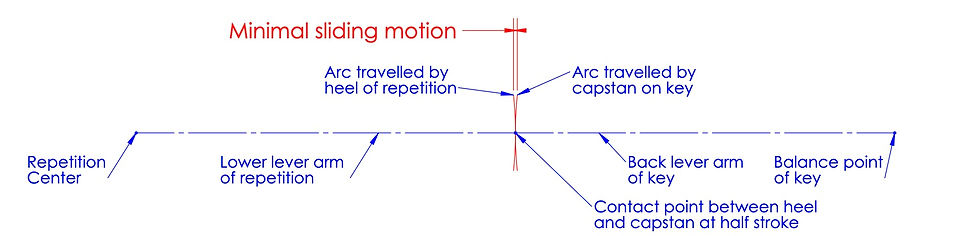
When the key and the repetition are at half stroke, the contact point between the capstan and the heel should fall on a straight line between the balance point of the key and the repetition center.
Proper attention to the half-stroke is fundamental to a well-designed key. As the key is played, the capstan moves in an arc, centered on the balance point of the key. The heel of the repetition moves in another arc centered on the flange center pin.
Because these arcs are different, a certain amount of sliding motion occurs where the
capstan and the heel meet. Unfortunately, sliding motion causes undesirable friction and should be minimized. To minimize sliding friction between the capstan and the heel, the contact point should lie on a straight line between the centers of the two arcs when the key is halfway through its travel.
Good Half-Stroke Design:
Good half-stroke design reduces friction between heel and capstan, resulting in better upweight in relation to downweight.
Poor Half-Stroke Design:

If the contact point between the heel and capstan is not on a straight line at half stroke, a far greater front-to-back motion results during the travel of the key. Excessive sliding motion between heel and capstan causes unnecessary friction between heel and capstan.
Half-Stroke for White Key
At half-stroke, the contact point between the heel and the capstan falls on the half-stroke line when the key is halfway through its travel.
Example shown: repetition with a 19 mm heel.

Half-Stroke Design for a Black Key
The Black Key Problem
The typical design for a white key poses a problem for the black key: Because the balance point of the black key is offset back from the white key, its half-stroke line is different:

Without changing the action, the contact point between the capstan and heel is no longer on the half-stroke line.

The Black Key Solution
If we increase the height of the heel by 2mm, we can bring the contact point down to the sharp half-stroke line. With Wessell, Nickel & Gross parts, that is easy to do! WNG supplies 9 different heels, varying in height in 1mm increments:
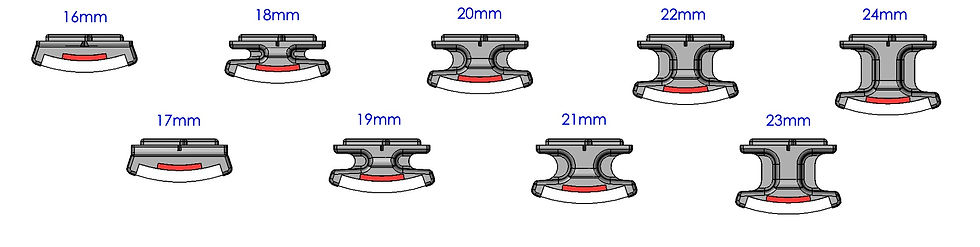
By increasing the heel by 2 mm, the contact point between heel and capstan can be made to fall on the half-stroke line when the key is halfway through its travel.
Example shown: 21 mm heel, 2 mm taller than for the white key:
With a 21 mm heel, 2 mm taller than the white-key example, the contact point now falls on the sharp half-stroke line.

Do you have an action rebuilding job coming up? Be sure to calculate the half-stroke line very carefully, and shop our repetition heel set for best results!